
If you’ve spent years building 3,000-word casino reviews or deep-dive sports betting guides, you might be looking at the rise of Generative Engine Optimisation (GEO) with a sense of dread. As we’ve previously established, traditional SEO and GEO are the ultimate partnership but that doesn’t mean your old content strategies will survive untouched. Are comprehensive guides dead? Do you need to delete your long-form content and pivot entirely to 300-word FAQs?
Let’s set the record straight right now: long-form content is not dead.
However, unstructured long-form content is rapidly losing its dominance. To win in the new era of AI search – dominated by Google’s AI Overviews, Perplexity, and ChatGPT – sheer word count is no longer a magic bullet. In fact, research into AI citation overlap shows that Google’s AI mode results share as little as 14% of their URLs with traditional top-ten search results. Being in Position 1 no longer guarantees the AI engine will actually cite you.
AI models don’t read web pages from top to bottom like human users do. They break documents down into smaller segments to retrieve specific answers. If your comprehensive sports betting guide mixes up moneyline explanations with parlay/multi rules in one long, rambling paragraph, the AI crawler will split the text mid-concept. The result? You lose the citation to a competitor, or worse, the AI hallucinates your betting rules.
It isn’t about writing less; it’s about structuring better. That is where semantic chunking comes into play.
What is Semantic Chunking? (The Technical Reality)
In the world of Large Language Models (LLMs) and Retrieval-Augmented Generation (RAG), engineers don’t feed an entire website into an AI at once. They break the data down into “chunks.”
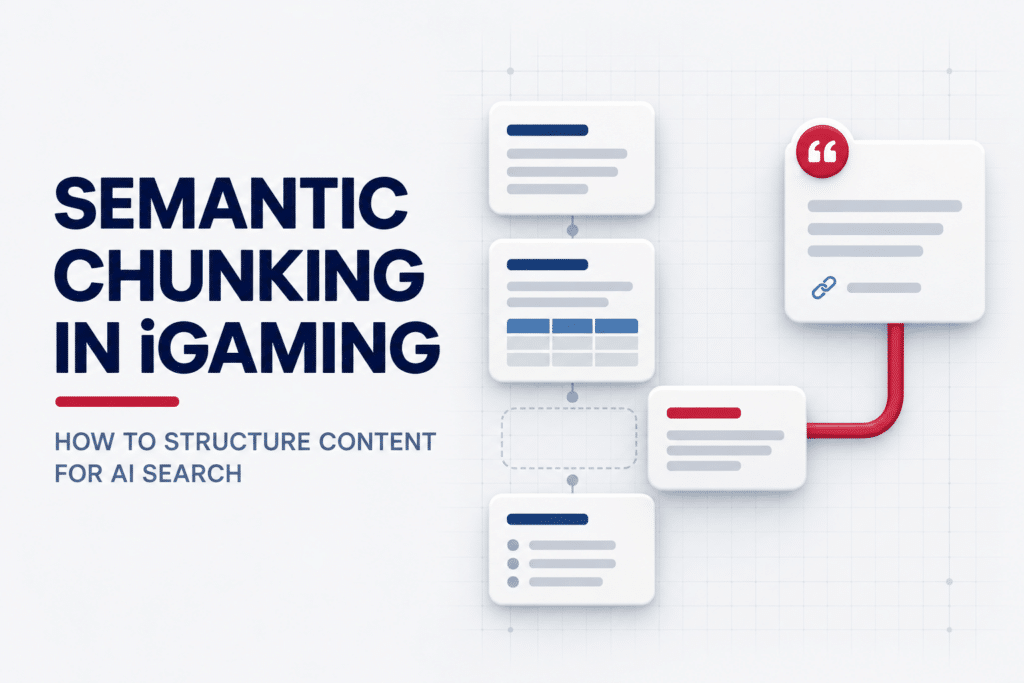
Traditionally, systems used “fixed-size chunking”, splitting text arbitrarily by character or token limits. But a vastly superior approach for complex information is semantic chunking. This method splits text where the meaning or topic shifts, rather than relying on arbitrary limits. It ensures that every segment of text retrieved by the AI is topically coherent and self-contained.
As an iGaming marketer, you cannot control how GPTBot or ClaudeBot have historically crawled your site, but you can control your content architecture. By manually applying the principles of semantic chunking to your writing, you spoon-feed AI crawlers the exact data they need to cite your brand. Getting cited in these AI responses is the new “Position 1” of search.
Case Study: Traditional Structuring vs. Semantic Chunking
To understand how this looks in practice, let’s look at a standard iGaming asset: a sportsbook Welcome Bonus page.
The Traditional Approach: A page might feature a generic H2 (“Welcome Bonus Terms”) followed by a dense, 500-word wall of text. Buried within that paragraph are the wagering requirements, time limits, minimum odds, and game weightings. When an AI attempts to extract just the minimum odds for a user query, it struggles to pull a clean answer without dragging along irrelevant context. The AI abandons the chunk and cites a better-structured competitor instead.
The Semantically Chunked Approach: Instead of a wall of text, the exact same information is broken down into modular, self-contained sections:
- H3: What is the Wagering Requirement? (Answered immediately in sentence one: “The qualifying welcome bonus wager requires a minimum bet of $10 at odds of +100/ 2.0 (Evens) or more.”)
- H3: Which Sports Contribute to the Bonus? (Followed directly by a clean, Markdown-friendly table detailing sports markets that contribute to the bonus).
- H3: What are the Minimum Odds? (A short, definitive answer regarding the qualifying bet).
The total word count might be identical, but the architecture is vastly different. The AI can now lift the exact “chunk” it needs for a highly specific, conversational query.
The Cost of Bad Chunking in iGaming
The iGaming sector is widely treated as falling within Google’s YMYL (Your Money or Your Life) crosshairs. Trust, accuracy, and E-E-A-T (Experience, Expertise, Authoritativeness, and Trustworthiness) are non-negotiable.
If an AI engine misinterprets your poorly structured withdrawal limits or KYC requirements, it doesn’t just result in a bad user experience. It damages your entity’s perceived trustworthiness. As we recently revealed in our State of Play: US iGaming Visibility Study, Google is already deploying AI Overviews for casino searches within days – and operators are actively being cited as sources. If your content is too difficult to parse accurately, you will be dropped from the LLM’s trusted knowledge graph entirely, and your competitors will claim those citations.
This isn’t about fragmenting your content unnaturally. It’s about reducing cognitive load for both human readers and search algorithms.
How to Chunk Your iGaming Content Today
So, how do operators and affiliates adapt their content pipelines for semantic chunking right now?
- Write Modularly: Ensure every section under an H2 or H3 can be read completely independently. If a section relies on a definition or context provided three paragraphs above it, it will fail as a chunk when retrieved by an AI.
- Answer First, Expand Second: Adopt a journalistic inverted pyramid for every single heading. Start your sections with direct, factual answers before adding marketing fluff, opinions, or expanded context.
- Master Micro-Formatting: Stop relying purely on prose. Use HTML tables for odds comparisons, bullet points for terms and conditions, and “Key Takeaway” summary boxes directly under headings. This structured data acts as a cheat code for AI crawlers.
Getting Your Content SEO/GEO Ready
Deep, authoritative iGaming content still matters, but the way we build it has fundamentally changed. In the era of GEO, your expertise is only as valuable as an AI’s ability to extract it. By adopting semantic chunking, you protect your hard-earned authority and ensure your sportsbook or casino remains the definitive, cited source in the next generation of search.